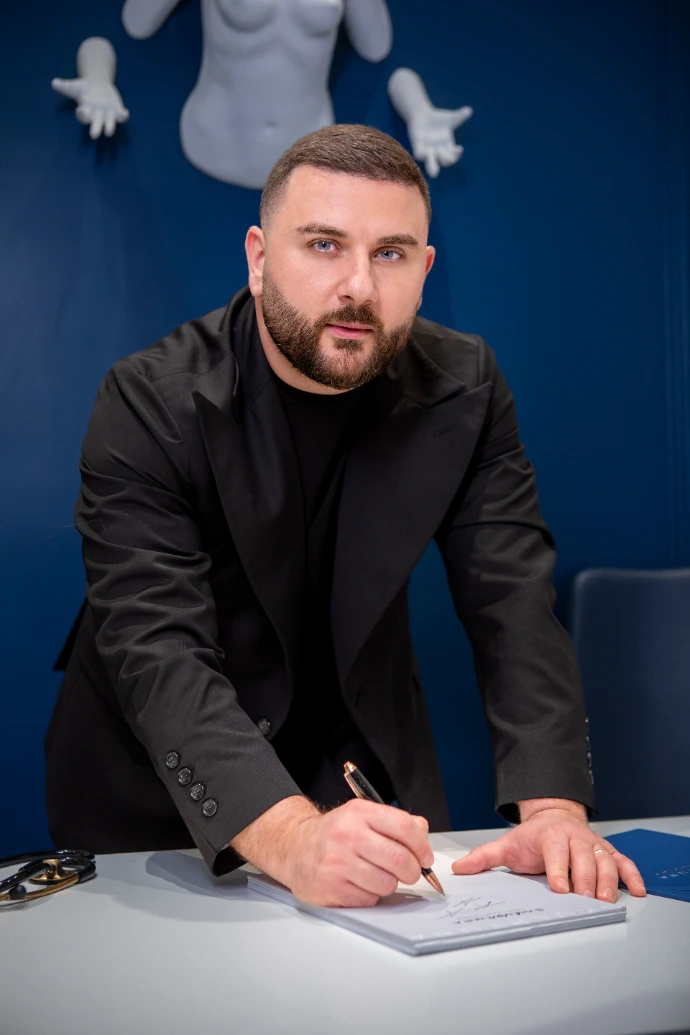
Plastic, Reconstructive & Aesthetic Surgeon
Dr. Pasquale Ruggiero
Clinical Educator | Aesthetic & Regenerative Medicine | Surgical & Procedural Innovation
Pasquale Ruggiero is a Plastic, Reconstructive and Aesthetic Surgeon whose professional activity integrates surgery, minimally invasive aesthetic medicine, clinical education and procedural innovation.
His work is grounded in surgical anatomy and in the belief that aesthetic medicine and surgery should not be considered separate disciplines, but different expressions of the same clinical reasoning.
Throughout his practice, he has progressively developed an approach based on anatomical precision, tissue behaviour, proportion and long-term treatment planning, with the aim of achieving results defined by balance and natural appearance rather than by the procedure itself.
Surgical Practice
Ruggiero’s current surgical activity is particularly focused on body contouring, periocular surgery, breast surgery and facial rejuvenation.
In body contouring, his work includes minimally invasive liposuction techniques aimed at enhancing definition while preserving natural anatomical proportions. His approach considers liposuction not simply as a method of volume reduction, but as a form of three-dimensional body remodelling.
His facial surgical practice includes upper and lower blepharoplasty, with particular attention to maintaining natural expression and balance within the periocular region.
Breast surgery also represents an important part of his activity, approached according to the same principles of proportion, anatomy and individualisation.
A growing area of his surgical interest is facial lifting, with particular attention to the integration of minimally invasive techniques with the anatomical principles of deep-plane facelift surgery. His approach is based on tailoring the extent of surgery to the patient’s anatomy, tissue descent and ageing pattern rather than applying a single technique to every face.
Aesthetic and Regenerative Medicine
Parallel to surgery, Ruggiero has developed extensive activity in minimally invasive aesthetic and regenerative medicine, with a particular interest in hyaluronic acid fillers, collagen biostimulation, poly-L-lactic acid, polynucleotides and regenerative treatment strategies.
His approach to injectables is strongly influenced by his surgical background, considering facial treatments in terms of anatomical compartments, vectors, tissue layers and structural relationships rather than isolated injection points.
This philosophy led to the development of the Equilibria Method, an integrated facial treatment concept combining poly-L-lactic acid, hyaluronic acid filler and polynucleotides within the same treatment session, while respecting different anatomical regions, injection planes and therapeutic objectives.
The method is based on the principle that facial ageing is a multi-layer process and should therefore be approached through different mechanisms: structural support, biostimulation and tissue quality improvement.
Each product maintains a specific role within the treatment plan, creating a coordinated but anatomically differentiated strategy.
Three-Point Non-Surgical Rhinoplasty
Another important area of his clinical work is non-surgical rhinoplasty.
Ruggiero has progressively refined a three-point approach to nasal reshaping, designed to minimise unnecessary injection sites while maintaining control over the principal aesthetic relationships of the nose.
The technique focuses on three strategically selected anatomical areas addressing inferior nasal support, tip projection and dorsal profile.
Its philosophy is intentionally conservative: rather than treating the nose through multiple injections and increasing volumes, the objective is to identify the smallest number of anatomically meaningful points capable of producing a significant visual change.
The concept reflects one of the principles that characterise his work: Minimal intervention does not mean minimal planning.
Clinical Education
Clinical education represents a major component of Ruggiero’s professional activity.
His teaching focuses not only on how to perform a procedure, but on the reasoning behind it: why a particular anatomical point is selected, why a specific plane is appropriate and how vectors, tissues and product characteristics influence the final outcome.
Anatomy therefore remains the foundation of his educational approach.
Rather than encouraging physicians to reproduce rigid protocols, his aim is to promote a deeper understanding of treatment planning and clinical decision-making, allowing techniques to be adapted to individual anatomy.
Clinical Innovation and Research
A defining element of Ruggiero’s professional development is the continuous interaction between daily clinical practice and procedural innovation.
New concepts often arise from recurring clinical questions: how can a treatment become more logical, more anatomically coherent, more reproducible or less invasive?
This perspective has influenced his work in injectables, regenerative medicine, non-surgical rhinoplasty and facial rejuvenation.
His interests increasingly extend to the integration of aesthetic medicine, regenerative science and skin longevity, with the aim of moving beyond episodic correction towards more comprehensive and biologically oriented treatment strategies.
He is also interested in the development of new protocols and medical concepts at the intersection of science, formulation, technology and clinical practice.
Innovation, in this context, is not considered valuable simply because it is new, but because it can offer a clearer biological rationale, a more coherent treatment strategy or a more predictable clinical outcome.
A Surgical Mindset Beyond Surgery
The common denominator throughout Ruggiero’s work remains surgical thinking.
Surgery has shaped the way he observes anatomy, evaluates proportions and anticipates tissue behaviour, and the same mindset is applied to injectables, regenerative treatments, clinical education and procedural development.
His professional identity therefore sits at the intersection of surgery, aesthetic medicine, regenerative science and medical education.
The objective is not to accumulate techniques, but to understand how different techniques can become part of a coherent clinical philosophy.
His approach can be summarised in three principles:
Understand the anatomy.Respect the tissues.Choose the smallest effective intervention capable of producing the greatest meaningful result.
PASQUALE RUGGIERO
Plastic, Reconstructive & Aesthetic SurgeonClinical Educator | Aesthetic & Regenerative Medicine | Surgical & Procedural Innovation
From anatomy to technique. From technique to a clinical philosophy.
Surgical thinking. Anatomical precision. Clinical innovation.
Latest Medical Journals
Explore fresh ideas and updates from our editorial team.